
The Most At Risk Form of Diversity: Diversity of Mind
4 minute read
We always speak on diversity of culture, ethnicity, and gender. However, there is a more invisible form of diversity that has made a major impact on the world, that we have not only neglected, but actively culled out of our society. It is perhaps the most important form of diversity, and that is Diversity of Mind.
Instead of honoring these differences, we’re systematically shaming and reshaping them to cram them into a more preferred form.
Modern psychology has defined very narrow parameters for what is considered “normal”Anything outside these is labeled a disorder, but what is a disorder, really?
It’s often not that a person’s mind is broken; it’s just that their way of thinking doesn’t align with the currently dominant system’s desires or preferred methods. We pathologize the difference, but difference isn’t dysfunction. It’s only perceived as dysfunction in a system that refuses to accommodate anything outside its blueprint
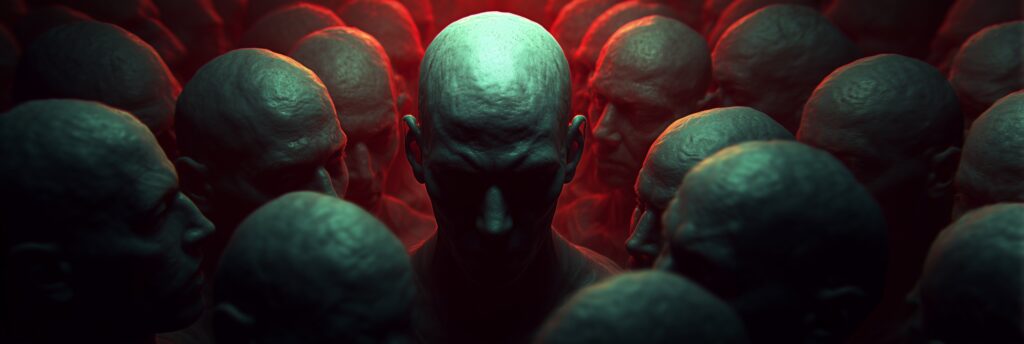
We push all the outer expressions of mind back into the center, bottlenecking consciousness, and I believe it’s one of the most dull and dangerous things we’re doing as a species.

The Dangers of Bottlenecking Consciousness
History, and evolution itself, is a chain of increasingly complex problems. Each time humanity solves a major problem, it creates a new set of conditions, usually more complex than the previous.
This next level of problem can’t usually be solved by the same type of thinking that created it.
To overcome the next threshold, we need minds that function outside the current paradigm, not minds that have been compressed into it.
The more we bottleneck behavioral patterns and thinking styles, the fewer of these diverse minds we leave in the system.
We risk creating a mental monoculture which makes us rigid and vulnerable
I can perceive a future crisis, whether environmental, technological, or societal, that demands a completely different way of perceiving the world.
When it comes, we may find we have already wiped out the exact cognitively diverse model needed to survive it.
This could very well be the type of mistake that has us ill equipped in the face of an extinction level risk.
Diversity of Mind in Practice
Take ADHD, for example.
We medicate children with ADHD not because they’re incapable of deep thought or creativity, but because they don’t conform to rigid classroom or workplace standards.
The system demands focus, stillness, and linear thinking. When thinking models and behavioral patterns don’t fit that mold, we call it a deficit.
In reality, these “distracted” minds often think in associative leaps and nonlinear insights. I’ve seen it myself many times.
One example is watching engineers, scratching their heads stuck on a problem for a week, only to have someone with ADHD walk through the room and immediately say, “Why don’t you just do it this way?” An answer so glaringly obvious once said aloud that all the engineers wonder how they didn’t think of it. That solution didn’t come from intense focus. It came from cognitive diversity.
Or consider schizophrenia. In many tribal cultures, the behaviors that helped select the important figure of a shaman were selected by what was known as shamanic sickness. This is what we now call schizophrenia. We pathologize states of being once recognized as signs of spiritual sensitivity of a prominent role of leadership. The shaman was responsible for the tribe’s vision, healing, and memory. Their altered perception was seen as sacred, not broken.
Our technological revolution could be said to be largely fueled by autism related traits. Diverse minds adapt and evolve in relationship to their environments, develop novel responses to unique & complex challenges.
We need the cognitive diversity.

The Problem Isn’t the Mind; It’s the System
It’s not always that people with divergent minds are broken. It’s that we’ve created no space for them to thrive.
We have created education institutions structured for a narrow scope of utility that takes into account the needs of compliance in a workforce but not the potential for unfathomable future challenges as our world grows increasingly complex.
Our schools are optimized for compliance, not curiosity. Our workplaces reward multitasking over insight. Our health systems favor symptom control rather than reframing and integrating.
We blame people for falling outside of this narrow scope of valued mental models instead of asking ourselves whether the range of it was ever wide enough in the first place. It leaves those on the fringes without support for the development of their own unique traits.
So we don’t need necessarily to “fix” all the people with nontraditional cognitive experiences. Granted some situations are more serious and dissonant than others.
We need to reimagine a society that has made space for them, and not only the space for them to exist naturally, but also the framework and support systems to thrive in their own type of being.
Imagine an educational system that helps children identify their cognitive style and refines it, building upon their inherent framework and mental model. Supporting them rather than punishing them for not fitting the mold.
We need to make space for those on the fringes of consciousness to flourish
Because some of the solutions to our biggest problems , even the ones that haven’t arrived yet, may only be solvable by the type of minds we haven’t made space for.
With the rate we are increasing in complexity, these unimaginable challenges may be here quicker than we can react to.
Diversity of mind may, in the end, be the most important kind of diversity there is.
If you enjoyed reading this please take a second to share it with your friends on social media
Come join the conversation on social media and share your thoughts.
Bring Home Some Cosmic Creations
-

Cosmic Contemplation (Framed photo paper poster)
$75.00 -

Cosmic Contemplation (Photo paper poster)
$60.00 -

Cosmic Wilderness (Framed photo paper poster)
$75.00 -
Cosmic Wilderness (Photo paper poster)
$60.00 -
Divine Mother (Framed photo paper poster)
$75.00 -

Divine Mother (Photo paper poster)
$60.00 -

High Resolution Realistic Cloud Brushes for Photoshop & Procreate – 15 Clean Hi-Res Brushes (3000-5000px, Royalty-Free)
$14.00 -
Inner Temple (Framed photo paper poster)
$99.00 -

Inner Temple (Photo paper poster)
$75.00